Swarm Agent Kit
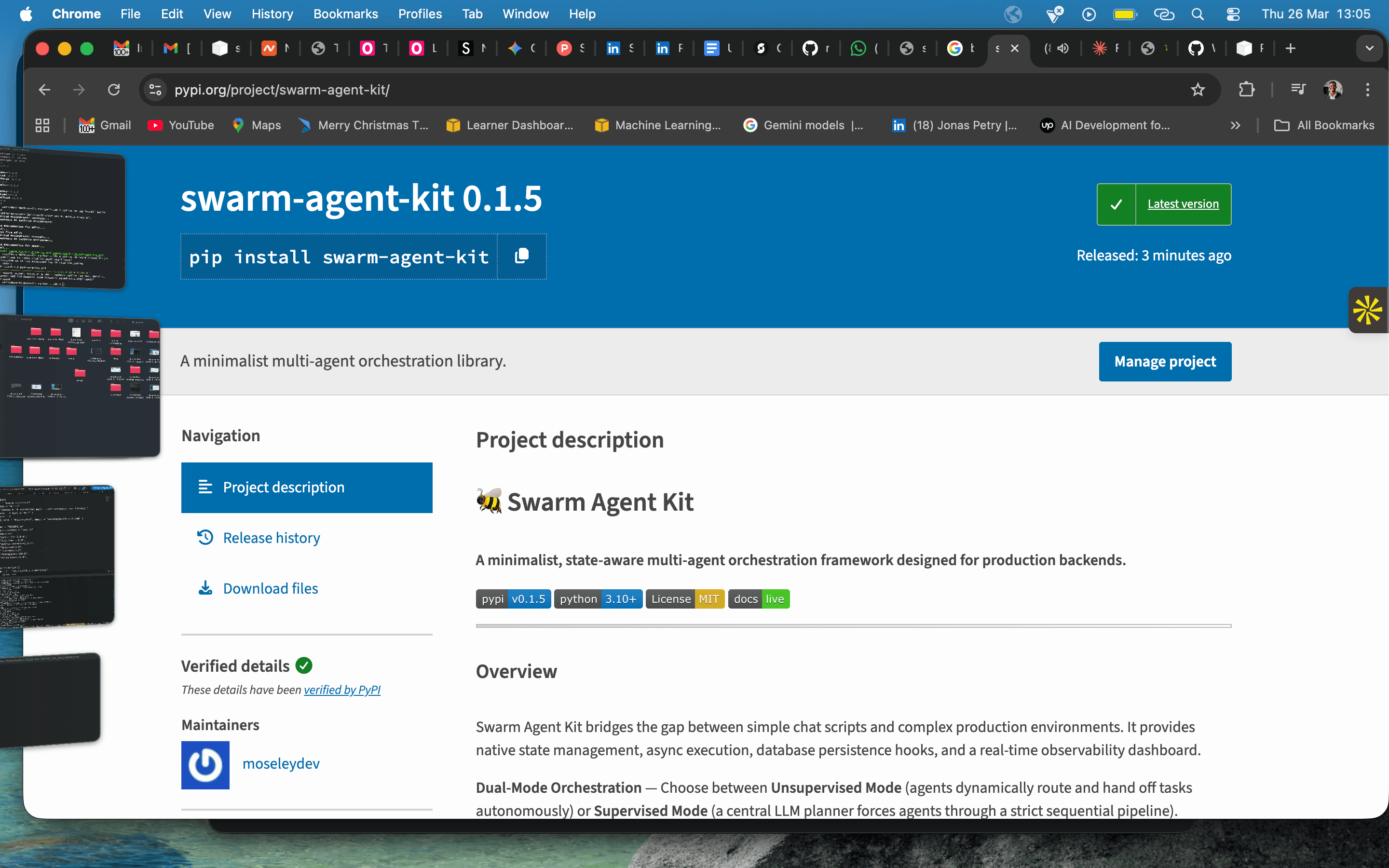
An open-source, production-ready multi-agent orchestration framework for Python backends. Built to fill the gap between simple LLM scripts and real production deployments.
The Challenge
Most multi-agent frameworks are either too opinionated (locking you into one provider or pattern) or too fragile for production use — no async support, no persistence, no observability. Developers building real products were forced to glue these things together from scratch every time.
The Solution
Swarm Agent Kit provides a minimal, composable foundation: dual-mode orchestration (autonomous handoffs or strict LLM-planned pipelines), native async/await support, BYOD persistence hooks for Redis or PostgreSQL, global state management across agents, and a built-in CLI dashboard for real-time observability. One pip install gets you production-ready.
What I Built
Designed the dual-mode orchestration engine — Unsupervised (agents dynamically hand off tasks) and Supervised (central LLM planner enforces a strict pipeline)
Built full async/await support safe for deployment inside high-concurrency frameworks like FastAPI
Implemented global state management allowing agents to share and mutate a shared memory dictionary, keeping context lean and token usage low
Created native BYOD persistence hooks — pass your own save/load handlers for Redis, PostgreSQL, SQLite, or any backend
Shipped a real-time CLI observability dashboard (swarm-kit studio) visualizing agent handoffs, tool executions, and state mutations
Integrated LiteLLM as the provider layer, unlocking 100+ LLM providers behind a single consistent interface
Published on PyPI with full documentation, quick-start guides, and MIT license
The Story
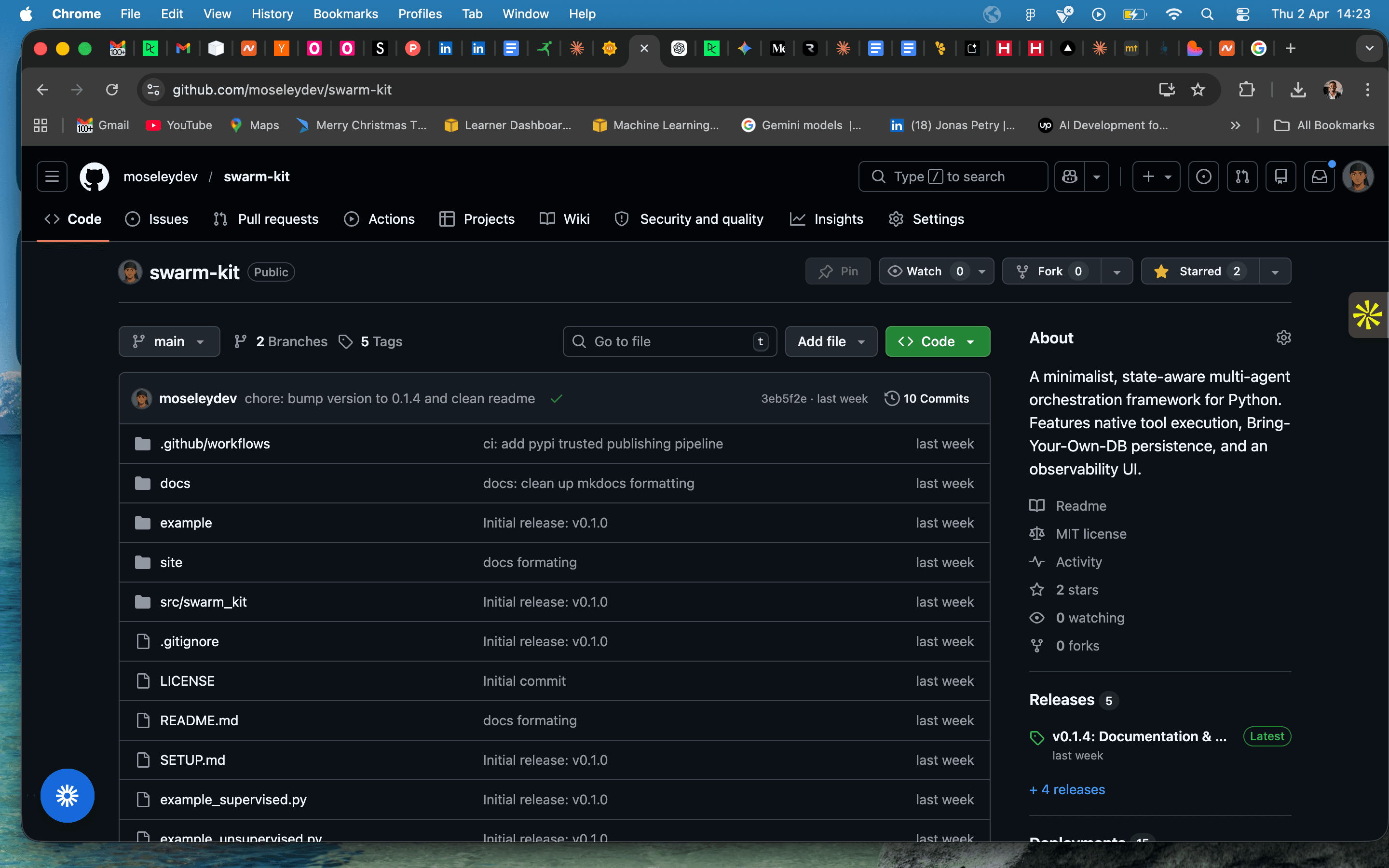
I started building Swarm Agent Kit while working on 100Minds.ai, where I needed agents that could hand off tasks between each other reliably in a FastAPI backend. Every existing framework either didn't support async natively or required vendor lock-in. I extracted the pattern I built for 100Minds, generalized it, and published it as an open-source library. It supports over 100 LLM providers via LiteLLM — so whether you're using OpenAI, Anthropic, Mistral, or a local model, Swarm Kit doesn't care.
What I Learned
Building a framework that other developers will actually use forced me to think deeply about API design — not just 'does this work' but 'will this still make sense six months from now when someone reads it at 2am.' State management across agents is deceptively hard. The real complexity isn't routing — it's ensuring global state stays lean, consistent, and doesn't balloon token usage as sessions grow. I also learned that good documentation is half the product.
Technologies Used
Back to
All Case Studies