Atlas Desk
An AI-first customer support ticketing platform with automated triage, routing tickets intelligently across WhatsApp, email, and chat — without human intervention on first contact.
The Challenge
Early-stage startups can't afford full support teams, but slow ticket response kills user trust. Most ticketing tools are designed for large teams — they're expensive, complex to set up, and don't understand unstructured customer messages from WhatsApp or email. Someone needed to build the layer in between: smart enough to handle first contact automatically, simple enough for a two-person team to run.
The Solution
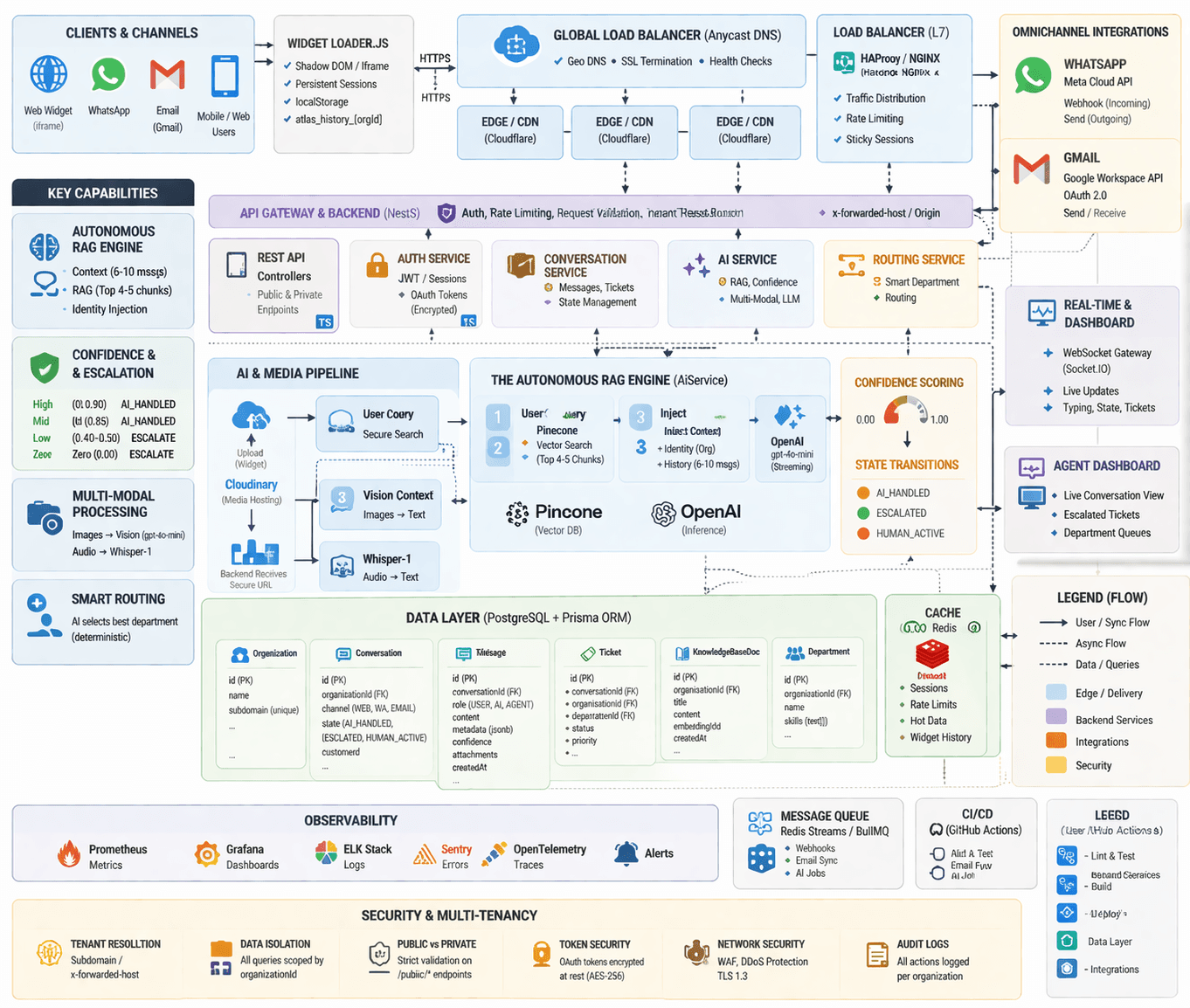
Atlas Desk is an AI-native ticketing platform where an agent layer handles the first pass — classifying intent, extracting urgency, and routing tickets to the right queue before a human ever sees them. It ingests messages from WhatsApp, email, and a chat widget into a unified inbox, and uses AI agents to triage automatically based on rules the team defines.
What I Built
Architected the full platform — unified inbox ingesting WhatsApp, email, and chat widget into a single queue
Designed the AI agent decision layer — classifying intent, extracting urgency signals, and routing tickets without human intervention
Built the confidence threshold system that escalates low-certainty tickets to human agents rather than acting incorrectly
Implemented the subscription billing system and multi-tenant architecture for SaaS deployment
Designed the operator dashboard for rule definition, queue management, and ticket audit trails
The Story
Atlas Desk started from a personal pain point — I was helping a startup manage support over WhatsApp and it was chaos. Messages got missed, priorities were unclear, and there was no audit trail. I started building a simple routing layer, which grew into a full platform once I saw how much of the triage work could be automated. The AI agent layer took several iterations — early versions were too aggressive and auto-closed tickets that needed human attention. Teaching the agent to know what it doesn't know was the hardest part.
What I Learned
AI agents in customer-facing contexts need a 'confidence threshold' — below a certain certainty level, the agent should escalate rather than act. I also learned that the most important feature isn't the AI triage, it's the unified inbox. Operators don't care about the AI until they trust the inbox. Get the basics right first.
Technologies Used
Back to
All Case Studies